Zahra and Chukwunonso present at CASCON
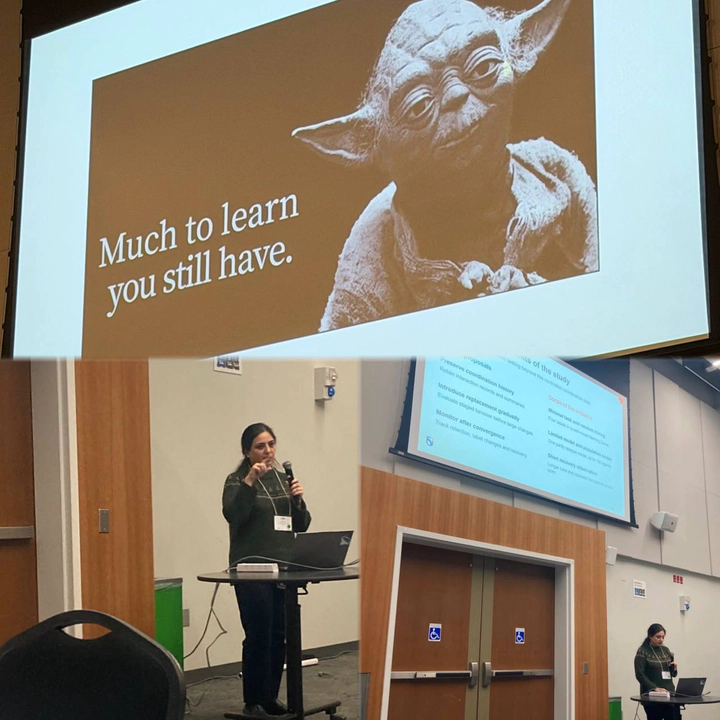 A selection of photos from the CASCON presentations
This week, Zahra and Chukwunonso travelled to Toronto to present at the 36th IEEE International Conference on Collaborative Advances in Software and Computing (CASCON).
Zahra’s work investigated what happens when AI agents establish a shared way to coordinate, and then lose their memories or some of the agents are replaced. To explore this question, the work used a Naming Game in which agents interact repeatedly to agree on a shared label. Once a convention emerged, they examined how it responded to memory loss and agent replacement. They also compared the coordination of LLM-based agents with that of a rule-based baseline. In their experiments, they found:
- 91% of the 200 simulated agent populations reached a shared convention.
- When all agents’ interaction memories were erased, the original convention persisted in 31.3% of runs.
- Retaining part of the interaction history helped stabilize coordination.
- Replacing agents was more disruptive than erasing the memories of the same proportion of agents.
Dr. Chukwunonso presented an empirical evaluation of adversarial training against label-flipping attacks across five streaming classifiers. The findings identified Streaming Random Patches and Leveraging Bagging as the strongest defence configurations, achieving F1-scores of 0.904 and 0.933, respectively, under the strongest poisoning conditions.
Great stuff, folks!